Making the Impossible Possible in Mathematics
Making the Impossible Possible in Mathematics
Author:
Superintendent Dr. Shawn Joseph

People power PGCPS.
I continue to be amazed by how hard people across Prince George's County Public Schools work to be transformative.
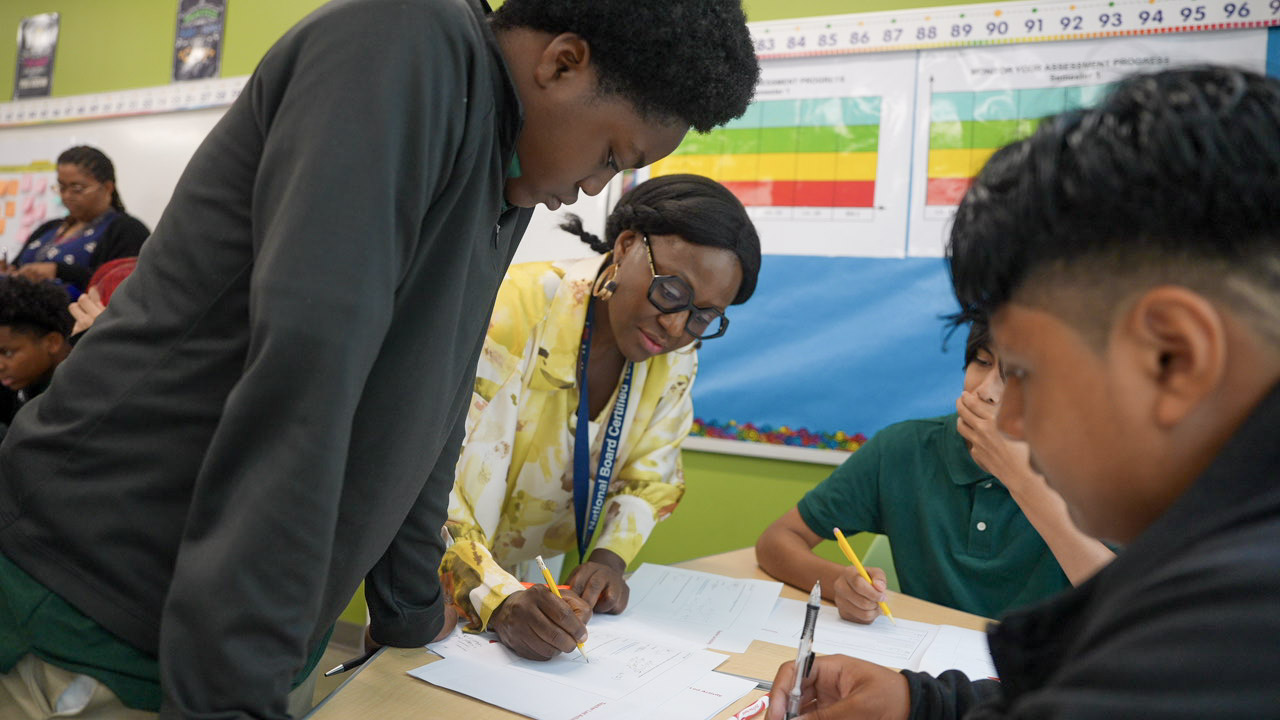
I see it in the bus driver who accepts an additional route because a child needs a safe ride to school and home. I see it in the teacher who gives up her lunch period to tutor students who need more time. I saw it again this weekend when members of our textbook team returned to work because elementary mathematics materials needed to reach schools this week.
Those acts may never appear on a dashboard or make the evening news, but they reveal something important about who we are. Transformation happens when ordinary people make extraordinary choices on behalf of children.
Last week, I visited CMIT Elementary School to meet a student named Amarah. Her mother is a foreman in our Transportation Department. During our recent transportation challenges, her mother gave hours of her time to help us solve problems and support families. One of those days happened to be Amarah's birthday.
I stopped by her school because I wanted to thank Amarah for sharing her mother with all of us.
As I walked through the building with two of our assistant principals, we passed a STEM lab. I found myself thinking about Amarah and her classmates and what we must do, intentionally and collectively, to ensure that they see themselves as mathematicians, scientists, engineers, innovators, and problem solvers.
Our plans and metrics mean little if Amarah's future is not filled with mathematical possibilities because of the intentional touches we make in her life. That is what this work is ultimately about.
This year, I am asking us to bring the same determination our people have demonstrated throughout this opening of school to one of the most urgent academic challenges before us: mathematics achievement.
Where We Start Is Not Where We Will End
We must begin with the truth.
Our mathematics performance is not where it needs to be. In 2025, 13.1 percent of PGCPS students were proficient across mathematics assessments, compared with 26.5 percent statewide.
The 2026 results tell another important part of the story. PGCPS mathematics proficiency improved in every grade from Grades 3 through 8 at a rate that outpaced improvement across Maryland. We improved on every mathematics assessment except Algebra I, where our performance remains approximately 10 percentage points behind the state.
That is progress. It is also a summons to do more.
Our comprehensive mathematics plan established annual growth targets of five percentage points across grades and courses. I want us to think even bigger. Our goal is to double the percentage of PGCPS students demonstrating mathematics proficiency over the next two years, using our 2026 results as the baseline for that work.
It can be done.
Doubling achievement does not mean asking our educators to work twice as hard. Our educators are already working hard. It means building a system that works twice as coherently around them.
The evidence that acceleration is possible is already emerging in our schools. We have schools producing double digit mathematics gains and educators showing us that when strong instruction, high expectations, timely intervention, and disciplined support come together, children accelerate. Our responsibility is to make that success less dependent on circumstance and more common across PGCPS.
Mathematics Is About More Than a Test
My research on the underrepresentation of Black women in STEM has reinforced something I believe deeply:
Talent is everywhere. Opportunity, access, expectations, and support are not.
When students struggle, our first question cannot be, “What is wrong with these children?” We must ask a more difficult question: What conditions must we change so that their brilliance can flourish?
That is a question about instruction, access, expectations, and ultimately, justice.
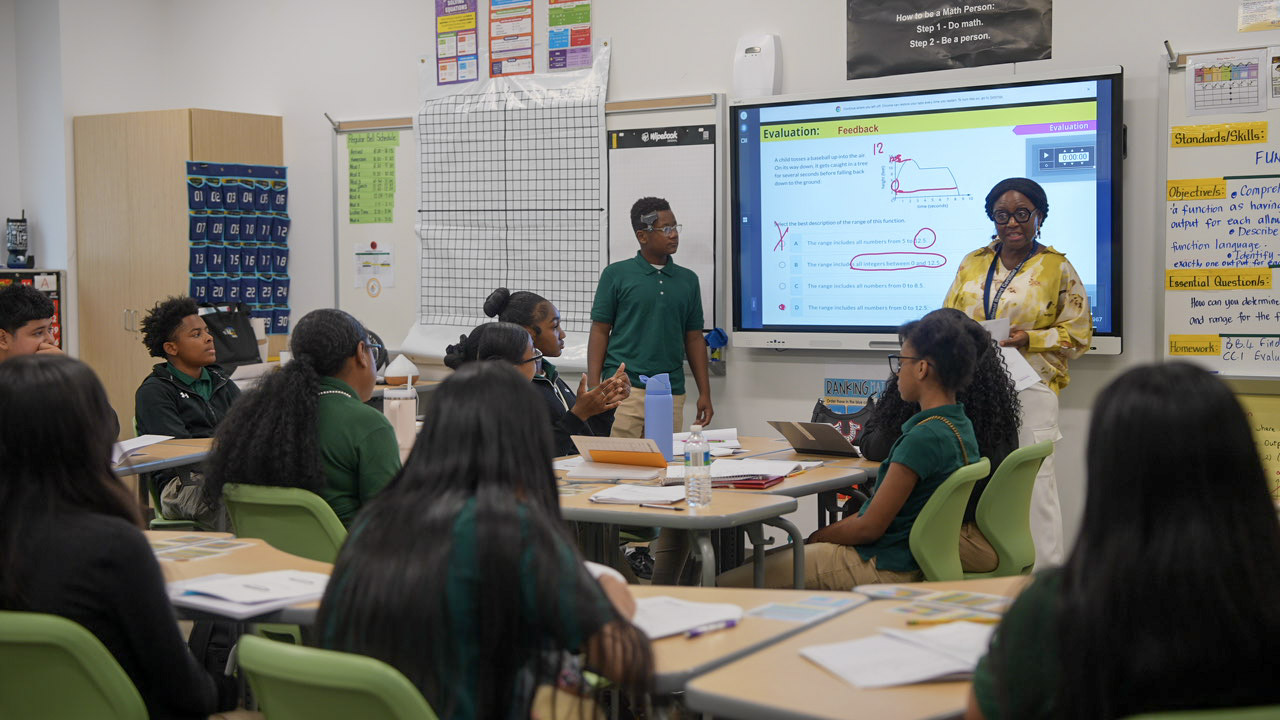
Mathematics opens doors to science, technology, engineering, computer science, advanced coursework, college, careers, entrepreneurship, and economic opportunity. Yet somewhere in PGCPS today is a child who has already begun to believe, “I am just not a math person.”
Our work is to interrupt that story before it becomes that child's identity. Every child deserves to encounter mathematics as a place of possibility, not as a gate that closes opportunity.
One Goal. One System. Coordinated Support.
We will not double achievement by asking teachers to work harder in isolation. We will improve by making the system around them stronger, clearer, more coherent, and more responsive.
For educators, that should mean four things.
- Clearer tools. Our Curriculum and Instruction team has streamlined resources aligned to revised standards, strengthened common assessments, clarified learning expectations, and expanded resources for reasoning, problem solving, and differentiation. Elementary students will have mathematics workbooks, and DreamBox will provide Tier 2 intervention support.
- Stronger support. Our 16 Math Accelerant Teacher schools are pairing job embedded Tier 1 coaching with focused Tier 2 intervention. Math Labs will give educators opportunities to observe powerful mathematics instruction in real classrooms and take effective practices back to their own students.
- Job embedded learning. Organizational Development, Curriculum and Instruction, and Technology are establishing common professional learning for mathematics coaches through monthly learning, school visits, feedback, coaching, and evaluation. Technology should support this work by making planning, differentiation, feedback, and intervention easier while keeping educator expertise at the center.
- Better evidence. Our Accountability team will examine student growth, proficiency on priority standards, teacher practice, coaching participation, collaborative planning, and implementation milestones so we can understand what is working and what must change.
We will study the work while we do the work. Our Chief Accountability Officer will report our mathematics progress to staff and the Board in January, April, and June, at a minimum, and we will adjust our strategy when the evidence tells us we must.
This is Forward by Design in practice: curriculum, professional learning, coaching, technology, assessment, accountability, and leadership moving together around the most important interaction in our system: what happens between a teacher and a child every day.
Accountability Belongs to All of Us
A plan does not change outcomes. People implementing a plan with discipline change outcomes, and accountability must run in every direction.
Teachers are accountable for strong instruction and for knowing whether students are learning.
Principals are accountable for protecting instructional time and creating the conditions in which strong teaching can flourish.
Those of us in central and area offices are accountable for providing schools the resources, clarity, responsiveness, and support necessary to succeed.
Accountability without support becomes compliance. Support without accountability becomes good intention without sufficient impact. Our children deserve both.
The quality of mathematics instruction a child receives cannot depend upon which school hallway that child walks down or which classroom door that child enters.
Amarah deserves opportunity. So does every child in every classroom across Prince George's County.
Making the Impossible Possible
Plans, curriculum, technology, and data matter. But none of them transforms a child's life by itself.
People do.
That is why people power PGCPS.
Some people may hear the words double mathematics achievement in two years and call the goal impossible. I do not.
History is filled with achievements once considered impossible until people decided the present condition was no longer acceptable. We have evidence that our students can accelerate. We have a clearer plan. We are building greater coherence. And most importantly, we have thousands of people throughout PGCPS who demonstrate every day that when children need us, they answer the call.
The same spirit that causes a bus driver to accept another route, a teacher to give up her lunch period, a transportation foreman to serve families on her daughter's birthday, and a textbook team to return on the weekend is the spirit that can transform mathematics achievement throughout this district.
The impossible becomes possible when people stop working as separate parts and begin moving as one system toward one promise.
Let us teach with the belief that every child can become a mathematician. Let us study our results without fear. Let us change what is not working and strengthen what is.
And let us never forget that behind every percentage point is a child like Amarah whose future may be changed because an adult saw possibility in her and intentionally opened a door.
Where we start is not where we will end.
We have the people.
We have the plan.
And we have children whose brilliance demands that we succeed.
Together, we can make the impossible possible.